Email Sending Task
Overview
Email Sending Task allows you to send emails while process execution. For successful sending, the Email add-on should be installed.
This is a custom task developed by Jmix, not BPMN standard task.
Graphical Notation
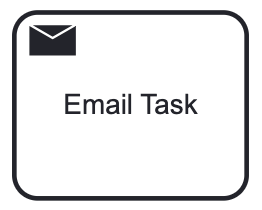
A service task is visualized as a rounded rectangle with a small envelope icon in the top-left corner. The icon is filled to represent task sending semantics.
Properties
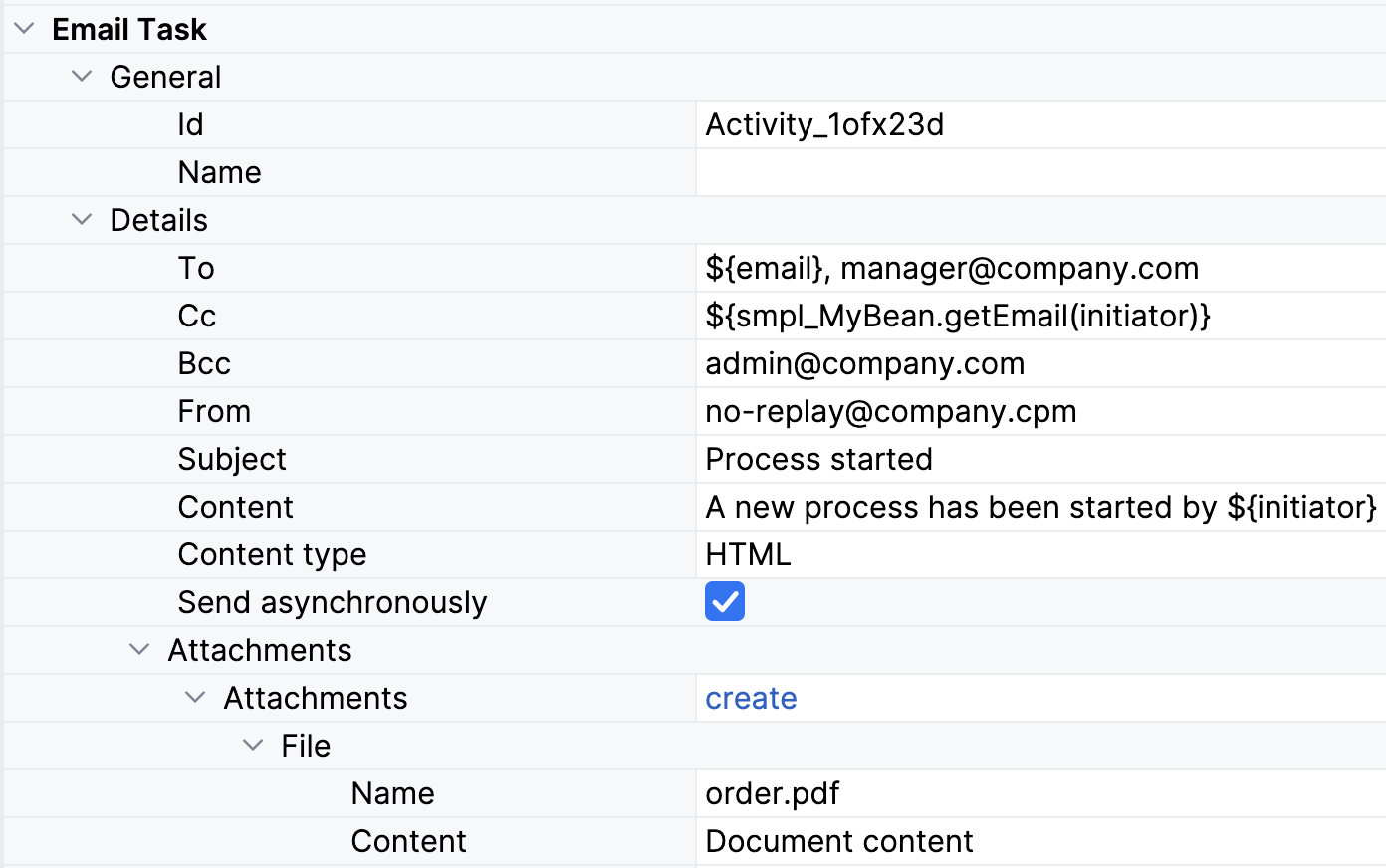
In the BPMN modeler, you can set the following properties of an email sending task:
Property |
Description |
Id |
The identifier of the element. It is generated automatically, but you can change it to a more meaningful one to make logs easier to understand. |
Name |
The name of the task, up to 255 characters. Tasks are typically named using a verb + object syntax, such as "Approve Order" or "Send Invoice". |
To, Cc, Bcc, From |
The addresses of the recipients and the sender. See Set Addresses. |
Subject, Content |
The subject and the body of the email. See Set Addresses. |
Send asynchronously |
Whether the email is sent asynchronously by the Email add-on. See Asynchronous Sending. |
Attachments |
See Attachments. |
Execution listeners |
See Execution Listeners. |
Asynchronous execution |
Updated in Jmix 3.1 |
Documentation |
A description and additional information about the element. |
|
Email sending task doesn’t have multi-instance properties available. But you can use it within an embedded subprocess that is multi-instanced. See the Multi-Instance section. |
Email Parameters
The email task has common parameters while sending emails — addressee, sender, subject, etc.
Set Addresses
-
Recipients addresses
-
To is for primary recipient addresses. You can use a process variable or expression to define the address, or input it directly. Multiple addresses are allowed.
-
Cc is for carbon copy recipients. You can use a process variable or input addresses directly. Multiple addresses are allowed.
-
Bcc is for blind carbon copy recipients. You can use a process variable or input addresses directly. Multiple addresses are allowed.
-
-
From is a sender’s address, so it allows only one entry. You can use either a direct value or an expression to set this field.
-
Subject contains the subject line of the email. It supports the use of process variables for dynamic entries.
-
Content represents the body of the email. In the editor, you can choose between HTML or plain text content types. Process variables can also be utilized in this section for dynamic content generation.
Asynchronous Sending
By default, emails are sent asynchronously. You can change this with the Send asynchronously checkbox.
Attachments
Use the Attachments section to include file content. The content must be supplied as an expression via a process variable or by invoking a Spring bean method that returns one of the following types: File, FileRef, byte[], or FileDescription.
Specifying an attachment name is optional. If a name is not provided, it will default to the name derived from the file content. When using byte[] for the file content, the default naming convention will be attachment_<incremental_part>.